
Rivian Gen 1 12V Battery Replacement Cost: 2026
See documented Gen 1 Rivian 12V bills from $404 to $775.04, compare battery configurations, and check the limits of warranty and DIY options.
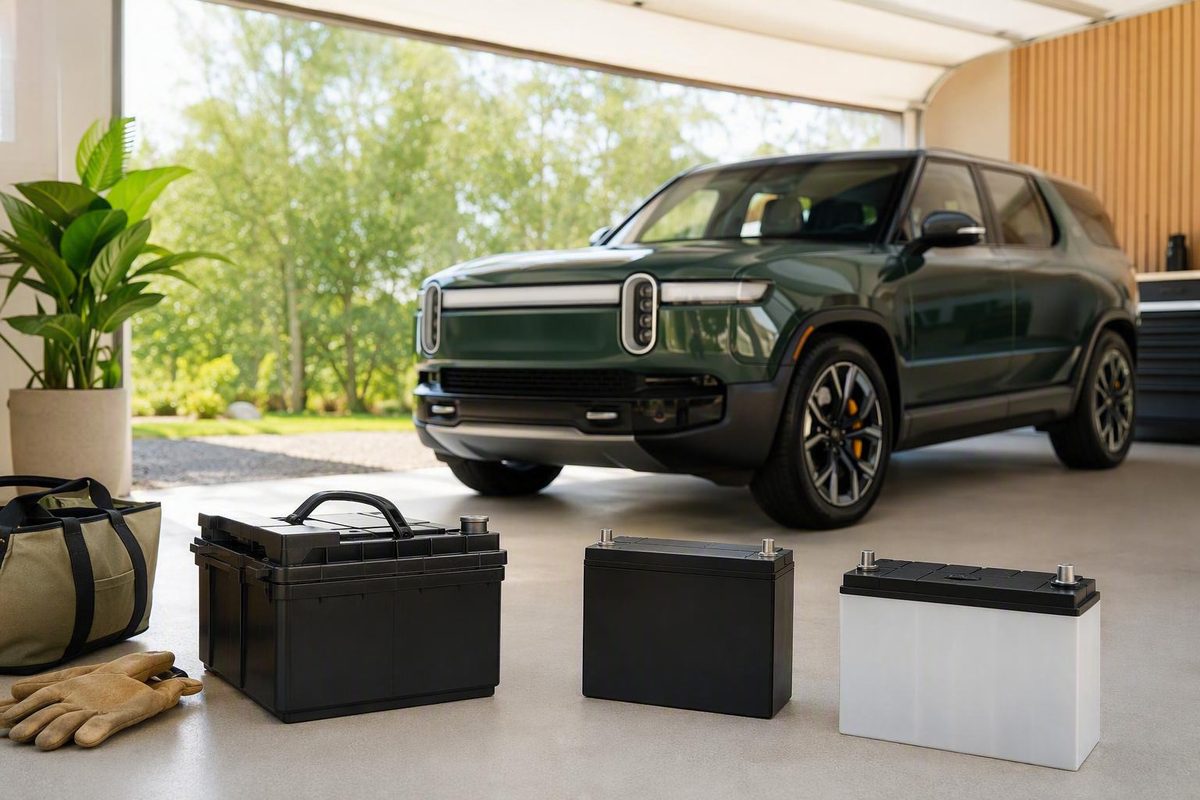
An out-of-warranty Rivian R1 Gen 1 12V replacement should be budgeted at about $500 initially, with $775.04 as the highest documented completed dual-battery invoice in the available evidence. Early Gen 1 vehicles can carry two batteries; later Gen 1 vehicles may have one battery and a capacitor. Rivian service remains the practical choice when warranty coverage applies or diagnostic-code clearing is required. The available evidence does not establish customer-pay replacement prices for Gen 2 or R2.
Choose the vehicle, coverage status, and replacement count to compare the documented service and DIY figures.
Replacement count means separate replacement events. Figures are planning references, not quotes. Unknowns remain marked with an em dash.
For one customer-pay Gen 1 event. The upper example is a completed dual-battery invoice, not a guaranteed maximum.
| Vehicle or event | Amount | Type | Adjustment or limitation |
|---|---|---|---|
| Gen 1, two batteries, October 2025 | $775.04 | Completed invoice | $511.30 parts; $231 labor; $32.74 tax or unexplained |
| 2022 dual-battery R1T, April 2026 | $617.52 | Estimate | Included stated $255 discount; components do not reconcile |
| Same 2022 R1T | $404 | Final payment | Additional discretionary goodwill |
| Gen 1, June 2026 | $496 | Completed payment | Configuration and adjustment not established |
| 2022 dual-battery vehicle, June 2026 | $505.52 | Completed payment | Adjustment details not established |
| 2023 R1T mobile service, June 2026 | $511 | Estimate | Not a confirmed payment |
| Dual-battery Gen 1, June 2026 | ~$505 | Revised payment | Two replaced; owner said only one was billed |
| Gen 1 aftermarket listing | $499 | Displayed product price | Dual-system package quantity and installed cost unclear |
| Gen 1 DIY proposal | ~$155 | First-time parts estimate | Experimental; not a verified completed repair |
| Gen 1 DIY proposal | ~$78 | Later parts estimate | Assumes terminal-relocation hardware can be reused |
| Qualifying original battery | $0 | Warranty result | Within 3 years or 36,000 miles, whichever comes first, and approved as covered |
| Gen 2 customer-pay service | — | No supported total | Select VINs reportedly received free replacements |
| R2 customer-pay service or DIY | — | No supported total | No documented figure in the supplied evidence |
Sources: Rivian official 12V guidance; owner-shared 2025 invoice; April and June 2026 owner reports; Ohmmu listing; RivianTrackr reporting. Estimates are marked ~ and unavailable figures are marked —.
Documented Gen 1 Costs Range From $404 To $775.04
Rivian does not publish a nationwide out-of-warranty Gen 1 replacement price in the supplied evidence. The available figures come from individual estimates, invoices, videos, and forum reports. Battery quantity, taxes, labor, warranty coverage, service method, and discretionary assistance can change the final amount.
| Report | Configuration | Amount | Important Context |
|---|---|---|---|
| October 2025 invoice | Two batteries | $775.04 | $511.30 parts, $231 labor, $32.74 tax or unexplained charges |
| April 2026 estimate | 2022 dual-battery R1T | $617.52 | Included a stated $255 discount |
| April 2026 payment | Same R1T | $404 | Reduced again through goodwill |
| June 2026 payment | Configuration unclear | $496 | No adjustment identified |
| June 2026 payment | 2022 dual-battery vehicle | $505.52 | Adjustment details unknown |
| June 2026 estimate | 2023 R1T, mobile service | $511 | Quote, not confirmed payment |
| June 2026 payment | Dual-battery Gen 1 | About $505 | Two installed, but reportedly only one billed |
The June figures came from owner discussions collected in a Rivian Owners Forum thread. They support a planning figure near $500, but they do not establish a standard price.
The $775.04 invoice is the clearest high-cost example. It covered two batteries and included $511.30 in parts plus $231 in labor. Those lines total $742.30, leaving $32.74 attributable to tax or other charges not separately explained in the owner-shared invoice report.
The $404 result is not the bottom of a normal price range. The owner first received a $617.52 estimate that reportedly included a $255 discount, then received additional goodwill. His component figures—about $511 for two batteries and approximately $325 for labor and sales tax—do not reconcile mathematically with the stated estimate after the discount. The reliable numbers are the stated $617.52 estimate and $404 payment, not a reconstructed undiscounted price. Both came from the owner’s firsthand service account.
Similarly, the approximately $505 dual-battery payment reportedly resulted from Rivian replacing two batteries while billing for one. That was a case-specific concession, not a published policy.
For an ordinary customer-pay repair, begin with about $500 but retain room up to the documented $775.04 dual-battery example. Neither figure is a guaranteed quote or ceiling.
Battery Count Determines Whether Another Owner’s Bill Is Comparable
“Gen 1” does not describe one low-voltage configuration. Early R1 vehicles may have two 12V batteries, while later Gen 1 vehicles may have one battery plus a capacitor.
An aftermarket seller divides fitment into these periods:
- Gen 1 dual-battery system: 2021 through 2023.3
- Gen 1 single-battery system: 2023.4 through 2024.6
- Gen 2 single-battery system: 2024.7 and later
These are seller-provided selection labels, not an authoritative Rivian VIN decoder. The seller tells buyers to inspect the vehicle before ordering and illustrates the dual system with two under-hood batteries and the single system with one battery and a capacitor on its configuration page.
Model year alone may not prove which hardware is installed. Ask Rivian to identify the VIN’s configuration, the number of batteries technicians will replace, and the number included in the parts total.
A quote should also state whether it includes labor, diagnostics, fault-code clearing, software work, tax, disposal, or a mobile-service charge. Without that detail, a dual-battery invoice and a later single-battery quote are not meaningful comparisons.
Warranty Can Reduce A Qualifying Original-Battery Repair To $0
Rivian states that a qualifying defective original-equipment 12V battery is covered for 3 years or 36,000 miles, whichever comes first. Rivian says it will replace a defective original battery without charge during that period. Damage or discharge caused by leaving the vehicle unplugged for an extended period is excluded, so a low battery does not automatically qualify for coverage under Rivian’s official guidance.
Both limits apply. A vehicle can pass 36,000 miles before its third anniversary or pass three years while remaining below 36,000 miles.
The owner who ultimately paid $404 reported receiving his warning at approximately 3 years 3 months and 37,000 miles. Rivian reportedly declined full warranty coverage but later provided goodwill. Owners close to the limit can request similar consideration, but another owner’s adjustment does not create an entitlement.
Ask Rivian to distinguish between coverage for the original battery and coverage for a customer-paid replacement. Forum participants have reported a replacement warranty of 2 years or 24,000 miles, but the supplied evidence contains no official Rivian document confirming that term for every replacement. Have the applicable parts-and-labor warranty placed on the estimate or invoice.
Reports of free Gen 2 replacements also do not establish Gen 1 pricing. Rivian reportedly contacted select Gen 2 R1 owners about a battery capable of causing a no-start condition and offered replacement without charge. The accompanying coverage described that issue as separate from earlier Gen 1 problems (RivianTrackr).
A $0 repair may result from original-battery warranty coverage, a VIN-specific service action, or discretionary goodwill. Gen 1 owners need a decision tied to their own VIN.
Gen 2 And R2 Customer-Pay Prices Remain Unestablished
The supplied evidence contains no documented customer-pay Rivian service invoice for a Gen 2 R1 or an R2. It therefore does not support applying the Gen 1 $500 planning figure or $775.04 dual-battery invoice to either vehicle.
The Gen 2 aftermarket selection shown at $499 is a product listing rather than an installed-service price. Free replacement reports for select Gen 2 vehicles reflect a specific remedy, not the normal out-of-warranty charge.
No supported R2 service or DIY total is available in the supplied evidence. Sharing a proprietary battery design would not, by itself, establish identical labor, access, diagnostics, warranty treatment, or installed cost.
Rivian Service Includes Work That Parts Prices Do Not
The October 2025 dual-battery invoice shows why an installed repair cannot be compared only with a battery listing. Its $511.30 parts charge was accompanied by $231 in labor and $32.74 in tax or other charges.
One R1T owner also reported that Rivian would not sell him the two OEM batteries for self-installation. The publication covering the dispute characterized those statements as the owner’s allegations and said Rivian had not confirmed them at publication (Carscoops). That account does not prove a nationwide parts-sales policy, but it shows why owners should verify availability before treating OEM parts as a DIY option.
Ohmmu displays a $499 sodium-ion option with Gen 1 dual, Gen 1 single, and Gen 2 selections. The supplied product page does not clearly establish whether the $499 dual-system selection includes one battery or a complete pair; its package wording refers to a singular battery.
That displayed price also does not establish shipping, tax, installation, diagnostics, code clearing, adapters, disposal, or compatibility work. Until quantity and installed scope are confirmed, it cannot be compared directly with a completed Rivian invoice.
DIY Estimates Do Not Yet Represent A Verified Repair Price
Owner discussions propose a first-time DIY parts total of about $155, followed by approximately $78 for later replacements if terminal-relocation hardware can be reused. These are shopping-list estimates, not documented completed-repair invoices.
The proposed approaches may involve terminal relocators, spacers, longer bolts, altered battery orientation, and custom or reused mounting hardware. The owner DIY megathread also leaves fitment and electrical questions unresolved.
A workable replacement must account for terminal orientation, cable reach, dimensions, hold-down security, current capability, cold-weather suitability, charging behavior, vehicle monitoring, and whether two units in a dual system should be matched. The battery must also be compatible with the vehicle’s charging voltage and behavior.
Rivian recommends using a certified technician. In October 2025, software executive Wassym Bensaid said the replacement involved in the public owner dispute required a diagnostic tool to clear error codes. He also said Rivian was developing an in-vehicle Service menu intended to support similar owner-performed repairs (RivianTrackr).
The promised menu does not yet change the DIY verdict in the supplied evidence. No release date, supported-model list, final feature set, or confirmation of current availability was provided. It also has not been established that every Gen 1 configuration and software version requires the same diagnostic step.
Until Rivian confirms that the menu is available for the specific VIN and can complete every required procedure, DIY owners must assume that installation may leave unresolved faults or require Rivian service. The meaningful comparison is between a completed Rivian repair and an experimental parts plan—not simply $775 versus $155 or $78.
A 12V Warning Requires Prompt Service
When the 12V battery warning appears, Rivian says replacement may be required within hours depending on battery condition and vehicle use. Contact Rivian and arrange service promptly.
Keep the vehicle plugged in while parked when feasible. The high-voltage system can support the 12V system, although the vehicle may remain awake and consume traction-battery energy more quickly. In the Shelton case, the owner observed approximately 5% to 10% traction-battery loss per day while unplugged during the fault. That is one owner’s observation, not a predictable drain rate.
Park where service or towing access is practical and remove essential belongings. A fully discharged 12V battery may prevent access and propulsion after the vehicle is parked.
Rivian advises against software or vehicle resets because they can delay diagnostics or produce an inaccurate diagnosis. It also says the trailer-hitch connections may provide enough power to unlock the vehicle and reach the frunk, but cannot recharge or jump-start the 12V battery.
Require A VIN-Specific Estimate Before Approval
The estimate should identify the low-voltage configuration, battery quantity, part numbers, unit prices, labor, taxes, fees, and diagnostic or software work. For a dual-battery vehicle, ask explicitly whether both batteries will be replaced and whether both will be billed.
Ask Rivian to check original-battery coverage, VIN-specific service actions, and possible goodwill before authorizing customer-pay work. If mobile service is available, confirm whether it changes the price or repair scope.
The estimate should also state whether fault-code clearing, battery registration, a software update, or another post-installation procedure applies to that VIN. Obtain the replacement parts-and-labor warranty in writing.
Save the original estimate, every revision, approval messages, warranty decisions, and final invoice. The documented figures from 2025 and 2026 are useful planning references, but only a current VIN-specific estimate establishes what a particular owner will pay.