
Battery Maintainer: What It Does and How to Choose One
Learn how a battery maintainer differs from a trickle charger, what ratings to check, and how to connect and monitor it during vehicle storage.
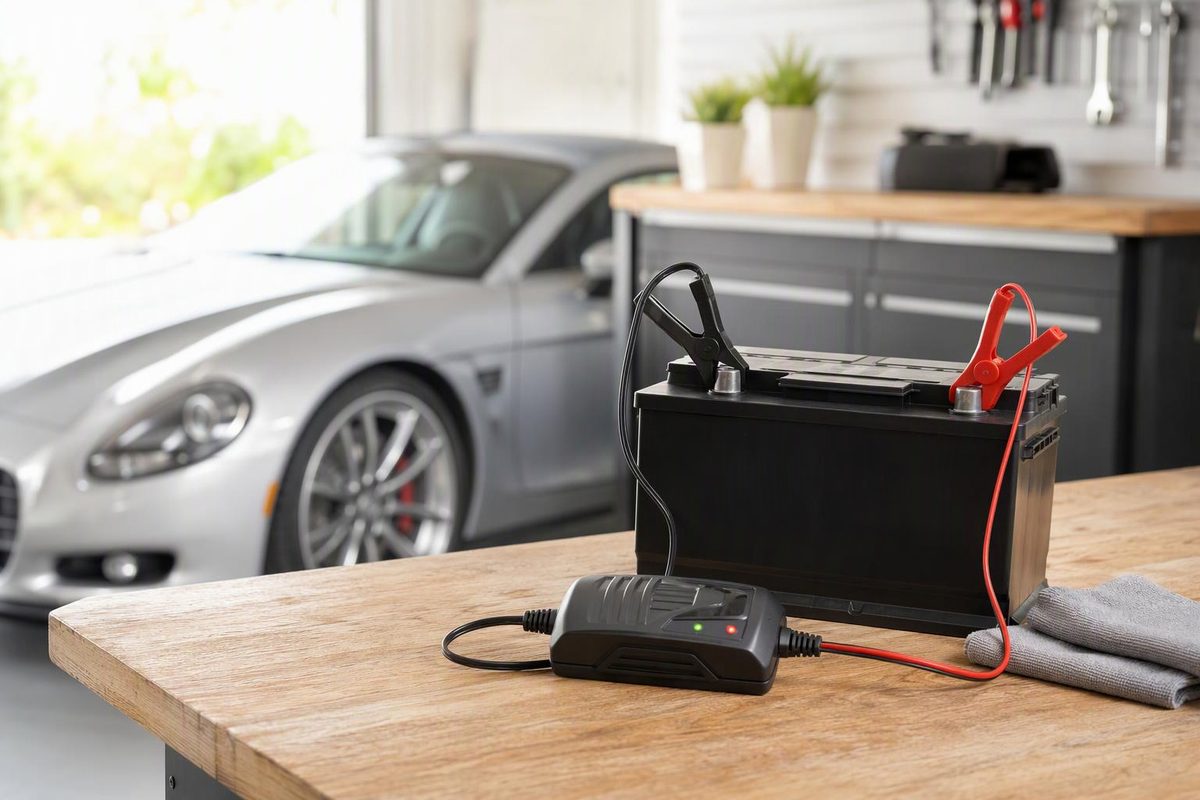
A battery maintainer is a charger with an automatic maintenance stage that keeps a battery charged while the vehicle sits unused. For a typical 12 V car battery, choose a unit that supports 12 V, the battery’s chemistry and its amp-hour (Ah) capacity, and explicitly permits long-term maintenance charging.
The important feature is what happens after the battery is full, not simply a low amp rating. Some maintainers hold a controlled float voltage; others monitor the battery and provide maintenance charging as needed. Battery Tender describes its float stage, while NOCO describes ongoing monitoring and maintenance cycles.
Maintainer, charger and trickle charger: the difference
These labels overlap. Read the operating instructions rather than relying on the product name.
| Label | What to check | Best suited to |
|---|---|---|
| Battery maintainer | Automatic maintenance stage approved for prolonged connection | Keeping a serviceable battery charged during storage |
| Battery charger | Charging current, chemistry settings and whether it includes maintenance | Recharging a depleted battery; storage too if maintenance is supported |
| Trickle charger | Whether it regulates charging after the battery is full | Long-term use only when the manual explicitly permits it |
| Battery Tender | Exact model’s voltage, chemistry and capacity ratings | It is a brand name, not a separate charging method |
An older, unregulated trickle charger can continue charging at an excessive voltage after the battery is full. Low current alone does not prevent overcharging. Battery Tender’s technical FAQ explains this distinction. Conversely, a modern product advertised as a “trickle charger” may include automatic maintenance, as the NOCO GENIUS1 does.
When a maintainer is useful
Consider one for a seasonal car, infrequently used truck or vehicle parked for an extended period with access to suitable electrical power. It can also help where short journeys repeatedly leave the battery undercharged. Volvo’s V90 battery guidance identifies prolonged non-use and short-distance driving as reasons to recharge.
There is no single parking-duration threshold that applies to every car. Battery condition and the vehicle’s electrical consumption change how quickly it loses charge.
Do not use a maintainer to hide a recurring fault. If the battery repeatedly goes flat during ordinary use, follow the battery and charging-system diagnostic guide before buying equipment. A maintainer does not establish whether the battery still has adequate starting capacity.
What to check before buying
1. Voltage and battery type
Identify the battery from its label and the vehicle manual. “12 V” does not identify the correct charging profile.
Check explicit support for flooded lead-acid, EFB, AGM or gel as applicable. For example, NOCO’s GENIUS1 instructions put EFB in its standard 12 V mode and AGM in a separate 12 V AGM mode. That is a model-specific instruction, not a setting rule for every charger.
A lithium replacement battery needs approval for its exact chemistry and battery-management requirements—not an AGM setting. The NOCO manual, for example, requires a built-in battery management system for its lithium mode and directs owners to consult the battery manufacturer. For a lead-acid battery, use the 12 V charger selection guide for the full compatibility checks.
2. Charging capacity versus maintenance capacity
Amps (A) describe charging current; amp-hours (Ah) describe battery capacity. Check both, including any separate maintenance limit.
For example, specifications checked on October 11, 2026 show:
- The NOCO GENIUS1 is rated at 1 A, with charging capacity up to 30 Ah; its manual separately says it maintains all battery sizes.
- The CTEK MXS 5.0 NA has a 4.3 A main charging program, charges batteries up to 110 Ah and maintains batteries up to 160 Ah.
These are examples of different charging and maintenance ratings, not comparative test results. Sources: NOCO user guide and CTEK specifications.
If you also need to recharge a substantially depleted car battery, choose equipment rated for that charging task. A small maintainer’s ability to preserve charge does not make it a fast recovery charger. See how long charging takes.
3. Storage environment and electrical demand
Check the AC input rating, permitted temperature range, moisture restrictions, cable reach and extension-cord requirements. Temperature compensation does not authorize use outside the manual’s limits.
Also account for equipment left running. A maintainer cannot keep up if connected loads consume more current than it can supply, and the manual may restrict running loads during charging. NOCO advises against this for GENIUS chargers. Switch off unnecessary accessories; do not treat a small maintainer as an RV or boat power supply.
How to connect and leave it safely
Follow the vehicle’s charging-point instructions and the maintainer manual. For example, the 2018 Volvo XC90 manual requires the vehicle’s negative charging point—not the starter battery’s negative terminal.
For a negative-ground vehicle, the CTEK manual gives this sequence: with AC power disconnected, attach red to battery positive and black to a suitable chassis or engine ground away from the battery—not fuel lines or sheet-metal body parts. Use designated charging points where the vehicle requires them. Then connect AC power and select the correct program. To disconnect, remove AC power first, then the ground clamp, then the positive clamp.
Wear eye protection, remove metal jewelry, provide ventilation and keep sparks or flames away. Do not charge a frozen or damaged battery. Protect leads from hood pinch points, hot surfaces and moving parts; do not cover the charger. Follow the CTEK or NOCO safety instructions for the equipment you use.
Long-term connection does not mean unattended operation. Confirm that the unit reaches its maintenance stage and follow its supervision requirements:
- CTEK requires the MXS 5.0 to reach Step 7 before prolonged unattended connection. If it has not reached that step within 50 hours, the manual says to disconnect it.
- Battery Tender recommends checking its Plus setup at least every couple of weeks.
- The NOCO GENIUS1 manual permits indefinite maintenance connection but also warns not to leave the product unattended while in use. Indefinite connection is not permission to ignore that warning.
Stop charging if the battery becomes excessively warm, leaks or swells. Investigate error indications according to the manual rather than repeatedly restarting the charger.