
How to Choose a 12V Lead-Acid Charger
Nominal 12V confirms voltage compatibility, but cannot identify the right charging profile for flooded, AGM, gel, EFB or sealed lead-acid battery designs.
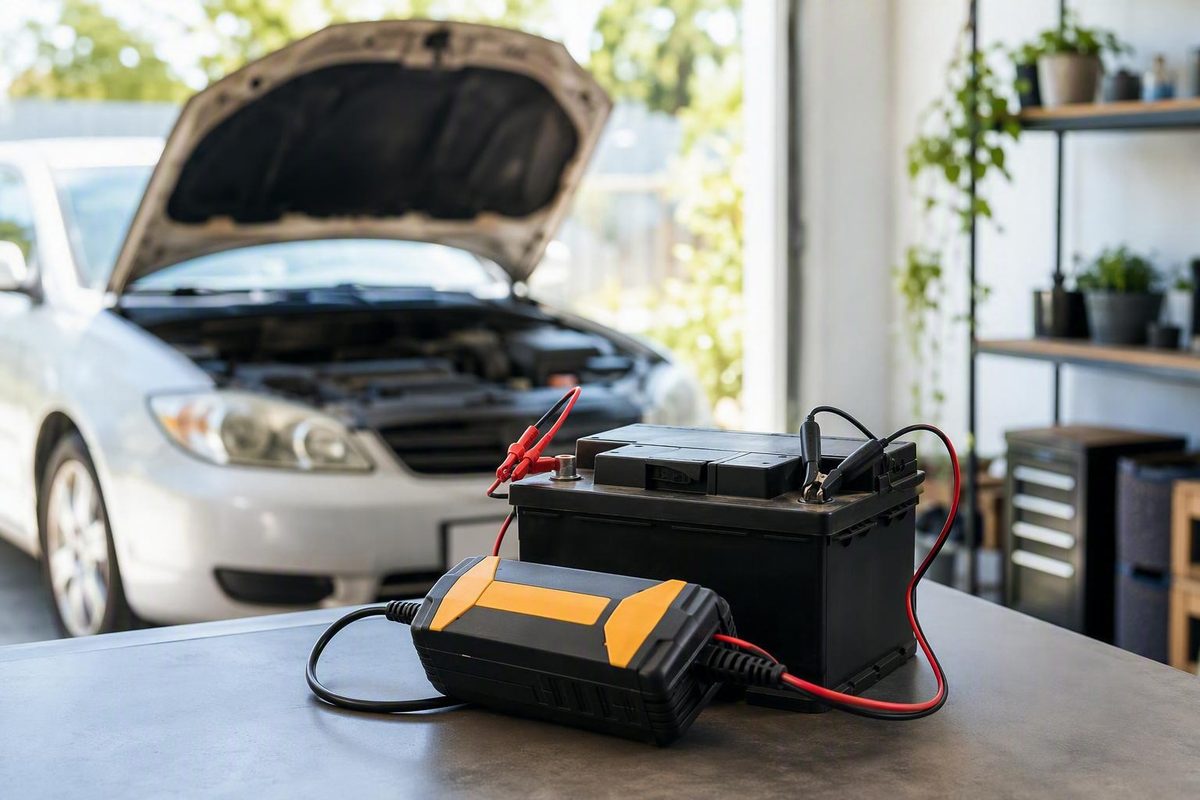
A battery charger for 12V lead acid batteries should be chosen from the battery outward—not from a marketplace ranking inward. “12V” confirms nominal-voltage compatibility, but it does not establish that the charger has the right profile for a flooded, AGM, gel, EFB, sealed lead-acid, or other battery design. It also says nothing about suitable current, maintenance behavior, temperature handling, connectors, or installation environment.
There is no universal best charger. The appropriate choice is the model whose documented charging profile fits the exact battery and the intended task: restoring a discharged starting battery, maintaining a stored motorcycle, charging a small sealed battery, or replenishing a large deep-cycle bank.
The five checks that identify the right charger
Before comparing models, answer five questions:
- Is the battery nominally 12V?
- What exact lead-acid subtype is it?
- What is its amp-hour capacity?
- Are you recharging it or maintaining it during storage?
- What charging limits and profile does its manufacturer specify?
Find the answers on the battery label, model datasheet, equipment manual, or vehicle manual. If the label is incomplete, search for the battery’s exact model number rather than guessing from its size or application.
1. Confirm nominal voltage
A 12V charger must support 12V batteries, but that is only the first compatibility check. A charger designed solely for 6V, 24V, or another nominal voltage is not a substitute.
A charger will normally raise terminal voltage above the battery’s nominal 12V rating during charging. Consequently, its controlled charging algorithm matters more than the large “12V” text on the case.
2. Identify the lead-acid subtype
Lead-acid labels overlap, but they do not mean the same thing:
These labels may describe chemistry, construction, or duty. A battery can carry more than one—for example, “deep-cycle AGM”—but that does not mean every charger advertised for “lead acid” supports it.
Some AGM batteries and other variants require a particular setting or profile. CTEK’s manufacturer-authored selection guidance likewise says that battery chemistry and subtype should be considered and that some AGM variants may need a different charging mode. That is commercial guidance rather than independent testing, so the current charger manual and battery datasheet remain decisive. See CTEK’s charger-selection guidance.
3. Find the amp-hour rating
Battery capacity is normally shown in amp-hours, abbreviated Ah—for example, 7Ah, 20Ah, 50Ah, or 100Ah. This is the capacity figure used when evaluating charger current and estimating charging time.
4. Decide between recharging and maintenance
A charger intended to replenish a substantially discharged battery may need more current than a device used only to offset self-discharge during storage.
A compact decision tree is:
- Small battery or storage maintenance: Start with a lower-current, regulated smart charger or maintainer.
- Routine automotive recharging: Consider a moderate-current charger if the battery manufacturer permits its current and voltage profile.
- Large deep-cycle battery: Consider higher current only within the battery’s documented limits.
- Permanent marine or onboard installation: Add environmental, wiring, and mounting requirements to the electrical checks.
A product called a “maintainer” should document regulated float behavior. The marketing name alone is not enough.
5. Read the battery manufacturer’s charging instructions
The battery datasheet should take priority over generic rules. Look for:
- Maximum or recommended initial charging current
- Cyclic or recharge voltage
- Standby or float voltage
- Temperature-compensation requirements
- Permitted charger types
- Restrictions for installed batteries or connected equipment
Lithium compatibility is a separate issue. A lead-acid profile should not be applied to a lithium battery simply because both use a 12V-class label. RELiON, a lithium-battery manufacturer, likewise recommends a lithium-specific charger rather than assuming lead-acid and lithium profiles are interchangeable. See RELiON’s chemistry comparison.
How charger amperage relates to battery capacity
Charger output is stated in amperes, while battery capacity is stated in amp-hours. The two can be related through C-rate notation.
For a 20Ah battery:
- 1C equals 20A.
- 0.1C equals 2A.
- 0.3C equals 6A.
This notation expresses charging current as a proportion of battery capacity.
Power Sonic recommends current-limited constant-voltage charging for its sealed lead-acid batteries and states that initial current during cyclic charging should not exceed 0.3C. This is manufacturer-specific SLA guidance—not a universal limit for every flooded, AGM, gel, EFB, automotive, marine, or specialty battery. Power Sonic documents the 0.3C limit and its SLA charging method here.
Applied arithmetically, that particular ceiling gives:
| Battery capacity | Calculation | Maximum initial current under this specific 0.3C guidance |
|---|---|---|
| 7Ah | 7 × 0.3 | 2.1A |
| 20Ah | 20 × 0.3 | 6A |
| 50Ah | 50 × 0.3 | 15A |
| 100Ah | 100 × 0.3 | 30A |
These figures are examples under Power Sonic’s cyclic SLA guidance, not automatic charger recommendations. A battery datasheet specifying a lower current overrides the calculation. Voltage profile, temperature behavior, and intended duty must also match.
What common charger outputs imply
Without declaring one output universally best:
- 1A: May suit gradual charging or maintenance where it falls within the battery’s documented range. It can be impractically slow for a large automotive or deep-cycle battery.
- 3A: Provides faster charging for many small-to-medium batteries, but may exceed the permitted current for a very small SLA battery.
- 5A: Can be a more practical automotive recharge rate when the battery permits it.
- 10A: Can reduce charging time for larger batteries but may exceed a small battery’s current limit.
Retail listings illustrate why current and capacity must be evaluated together. BatterySpace lists 12V SLA options at 0.8A for 0.8–20Ah, 1A for 1–10Ah, 3A for 3–25Ah, and 10A for 10–110Ah. Those are retailer-listed product ranges, not universal battery limits, and each should be confirmed against the current product manual and battery datasheet. Review the BatterySpace comparison table.
More current is not automatically better. Excessive current can conflict with a small battery’s charging specification, while an undersized charger may be electrically permissible but too slow for the intended job.
Estimate charging time without promising an exact result
A useful planning formula is:
Ideal charging hours = amp-hours needing replacement ÷ charger amperes
The key phrase is needing replacement. Do not divide total rated capacity by charger current unless the full capacity genuinely needs to be replaced and that assumption is reasonable for the battery’s condition.
For example, a 50Ah battery believed to be at approximately 50% state of charge has a nominal deficit of about 25Ah:
25Ah ÷ 5A = 5 ideal hours
That is an arithmetic baseline, not a promised completion time.
Ideal minimum-time table
The table below uses deficits of 3.5Ah, 10Ah, 25Ah, and 50Ah, corresponding arithmetically to half the rated capacities of 7Ah, 20Ah, 50Ah, and 100Ah batteries. It also compares each current with the illustrative Power Sonic 0.3C ceiling discussed above.
| Capacity to replace | 1A charger | 3A charger | 5A charger | 10A charger |
|---|---|---|---|---|
| 3.5Ah in a 7Ah battery | 3.5 ideal hours | Exceeds the illustrative 0.3C ceiling | Exceeds the illustrative 0.3C ceiling | Exceeds the illustrative 0.3C ceiling |
| 10Ah in a 20Ah battery | 10 ideal hours | 3.3 ideal hours | 2 ideal hours | Exceeds the illustrative 0.3C ceiling |
| 25Ah in a 50Ah battery | 25 ideal hours | 8.3 ideal hours | 5 ideal hours | 2.5 ideal hours |
| 50Ah in a 100Ah battery | 50 ideal hours | 16.7 ideal hours | 10 ideal hours | 5 ideal hours |
“Exceeds the illustrative 0.3C ceiling” does not mean universally unsuitable. It means the combination exceeds Power Sonic’s cited cyclic SLA guidance; the identified battery’s own datasheet determines whether that current is allowed.
A half-discharged 7Ah battery needs roughly 3.5Ah replaced, so charging at 1A will take more than 3.5 hours in practice. Replacing 25Ah in a half-discharged 50Ah battery takes at least five ideal hours at 5A. Replacing a 50Ah deficit at 1A has a 50-hour ideal baseline—more than two days before tapering and losses are considered.
The charger’s advertised maximum current is not necessarily delivered throughout the cycle. During absorption, the charger controls voltage while the current accepted by the battery normally declines.
For automotive context, Car and Driver says many car-battery chargers provide approximately 2–6A and that charging can take several hours or overnight. Those broad figures are not guarantees and should not be applied to every battery size or subtype. See its automotive charging overview.
Finally, distinguish topping up a healthy, partly discharged battery from attempting to recover one that is deeply discharged or no longer accepting charge normally. The second situation may require testing and diagnosis rather than a longer time estimate.
Smart charger, maintainer, or trickle charger?
These terms are often combined in product titles, but they describe different behaviors.
Smart charger
A smart charger monitors battery conditions and adjusts current or voltage as charging progresses. A typical multistage process includes:
- Bulk or constant-current stage: Replaces energy relatively quickly while limiting current.
- Absorption or constant-voltage stage: Holds a target voltage while the battery’s accepted current declines.
- Float stage: Maintains charge at a lower regulated voltage.
Not every charger uses identical stage names or transitions. The manual should explain what the model actually does and which batteries each mode supports.
Maintainer
A maintainer is best defined by documented behavior rather than branding. It should provide regulated float maintenance suitable for the battery subtype and intended application.
A charger that completes a recharge and then enters an appropriate float mode may function as a maintainer. Whether it can remain connected indefinitely depends on the charger instructions, battery requirements, temperature, and installation—not merely the words “automatic” or “smart.”
Trickle charger
A basic fixed-output trickle charger continuously supplies power without automatically adapting to battery condition. Battery Tender’s vendor-authored comparison distinguishes this from a smart charger that monitors charge level and adjusts its output; it also warns that a fixed-output charger can overcharge a battery if left connected too long or if its rate is unsuitable. Read the trickle-versus-smart comparison.
Leave a charger connected continuously only when its documentation explicitly permits indefinite regulated float maintenance for that battery type and application.
Cyclic and float voltages are different
For its SLA batteries, Power Sonic specifies 2.45 ± 0.05V per cell as a cyclic full-charge target and 2.25–2.30V per cell for standby float service. For a nominal six-cell 12V lead-acid battery, the arithmetic equivalents are approximately:
- 14.7V nominal for the cited cyclic target
- 13.5–13.8V for the cited standby float range
The same manufacturer guidance says temperature compensation is particularly desirable outside 5–35°C and warns that insufficient voltage can leave sulfate on the electrodes, while excessive voltage can cause overcharging and contribute to thermal-runaway risk in SLA batteries. These figures and cautions apply to the cited SLA guidance; they are not universal settings for every lead-acid subtype. Consult the Power Sonic charging guide for the complete conditions.
Reconditioning and desulfation modes
“Reconditioning,” “desulfation,” and “pulse repair” generally describe optional functions claimed to address some effects associated with sulfation or deep discharge. Their presence does not prove that a charger can restore lost capacity, reverse internal damage, or make a failed battery serviceable.
Treat these modes as secondary features. First verify normal charging current, voltage profile, float behavior, and operating instructions.
Compatibility and feature checklist for comparing chargers
Use this checklist before purchasing.
Electrical compatibility
- [ ] Correct nominal voltage
- [ ] Explicit support for the exact flooded, AGM, gel, SLA, VRLA, or EFB subtype
- [ ] Stated battery-capacity range that includes your battery
- [ ] Output current within the battery manufacturer’s limits
- [ ] Documented bulk, absorption, and float behavior
- [ ] Correct distinction between cyclic charging and standby maintenance
- [ ] Separate documented mode if lithium charging is advertised
- [ ] Minimum battery-detection voltage disclosed
That refusal is not evidence that the battery can safely be recovered by bypassing detection. Do not use a force or override mode without the exact model manual.
Temperature behavior
Appropriate charging voltage varies with battery temperature. Look for built-in temperature compensation, a remote sensor, or clear manual adjustments. Apply any thresholds only to the battery and charger documentation that specifies them.
Claimed protective behavior
Check whether the documentation explains what happens during:
- Reverse polarity
- Overcurrent
- Overvoltage
- Output short circuit
- Clamp contact or spark conditions
- Excessive charger temperature
Treat these as manufacturer or seller claims unless independently verified. A product page displaying UL, CE, TUV, FCC, or another mark does not by itself establish that the current model and configuration have a valid certification. Confirm the exact model in its documentation and, where possible, in the issuing organization’s database.
Connectors and physical usability
Confirm:
- Alligator clamps, ring terminals, or barrel connector
- Barrel-plug dimensions and polarity
- Cable length and reach
- Inline fuse location and rating
- Availability of replacement leads or adapters
- Strain relief and suitability for repeated handling
PowerStream, for example, lists two versions of a 1.5A wall charger: one with alligator clips and another with a 5.5-by-2.1mm center-positive barrel connector. The same vendor lists a 90–264VAC, 50/60Hz input and a three-stage charging algorithm. These are model-specific vendor specifications, not proof of compatibility with every battery or regional outlet. Check the PowerStream model details.
Installation environment
For marine, onboard, outdoor, or damp locations, require an environmental rating appropriate to the installation. Do not assume a household wall charger is suitable merely because it can charge the same battery electrically.
A permanently installed charger may also require appropriate mounting, protected wiring, vibration resistance, moisture protection, installation clearances, and system-specific instructions. Confirm regional plug type and AC input range before ordering.
Ownership details
A technically plausible charger can still be a poor purchase if its documentation or support is inadequate. Compare:
- Manual availability and clarity before purchase
- Status indicators and fault codes
- Behavior after AC power is interrupted and restored
- Warranty terms
- Return period and exclusions
- Availability of replacement connectors
- Consistency among the box, listing, datasheet, and manual
Best-fit charger profiles by application
The following profiles organize the decision by use rather than declaring one model the winner.
Small 7Ah SLA battery
Under the cited Power Sonic 0.3C cyclic guidance, a 7Ah SLA battery would have a 2.1A maximum initial current. A documented smart charger around 0.8–1.5A may therefore be plausible for a battery governed by comparable limits, provided that:
- Its capacity range includes 7Ah.
- Its cyclic voltage matches the battery datasheet.
- It supports the exact SLA subtype.
- Its connector dimensions and polarity match.
- Its float behavior is suitable for standby use.
Do not infer that every 7Ah SLA battery has the same limit. Select 3A or more only when the identified battery’s documentation allows that current.
Motorcycles and powersports equipment
Priorities include:
- Explicit support for the battery subtype
- Low-to-moderate current appropriate to its Ah rating
- Regulated float maintenance for seasonal storage
- Compact ring-terminal or quick-disconnect leads
- Correct polarity and documented fault behavior
- Environmental suitability for the connection location
Stored car
Choose an automatic maintainer with documented float behavior rather than assuming a fixed-output trickle charger is appropriate for months of continuous use.
Check the vehicle manual for approved connection points, installed-battery charging restrictions, battery-monitoring sensors, alarm systems, and accessory loads.
Routine automotive recharging
A 1A charger may recharge or maintain some car batteries, but it can be slow when the capacity deficit is large. A moderate-current charger may be more practical when the battery manufacturer permits its current and voltage profile.
Capacity and subtype matter more than the word “car” in a listing. A charger marketed for cars may still have a narrow capacity range or lack the mode required by a particular AGM or EFB battery.
50–100Ah deep-cycle, RV, or marine battery
Prioritize:
- A documented capacity range that includes the battery
- Current high enough to be practical but within battery limits
- Explicit support for the deep-cycle subtype
- Temperature compensation
- Suitable cyclic and float profiles
- Appropriate environmental construction
- Cable sizing and connectors suitable for the charging current
For permanent marine or onboard charging, also evaluate waterproofing, vibration resistance, independent bank outputs, mounting requirements, and system-specific installation instructions. These are selection criteria, not features guaranteed on every marine-labeled product.
Documented commercial examples
The examples below summarize manufacturer, seller, retailer, or marketplace claims. They are not independent performance results or recommendations. Current manuals should be checked before purchase.
| Commercial example | Advertised output | Documented or claimed fit | Evidence type and buying caution |
|---|---|---|---|
| NOCO GENIUS1 marketplace listing | 1A | Listing claims 6V/12V support, wet, gel, AGM, and separate lithium capability | Marketplace and advertiser claims; sponsored placement does not establish suitability or superiority |
| ExpertPower 12V charger | 1A | Seller claims support for lead-acid batteries of 5Ah or more and automatic transition to float | Direct-seller claim; charging voltages, connector details, and indefinite-use instructions should be verified |
| PowerStream wall charger | 1.5A | Vendor claims support for 0.7Ah to more than 20Ah flooded, SLA, VRLA, gel, and AGM batteries | Vendor specification; verify the exact connector version and battery profile |
| BatterySpace SLA options | 0.8A, 1A, 3A, and 10A | Retailer lists model-specific ranges extending from 0.8Ah to 110Ah | Retailer category data; confirm the current manual and certification status |
The NOCO marketplace result is sponsored, so placement and customer ratings are not technical evidence. The ExpertPower seller page claims that its 1A charger supports 12V lead-acid batteries of 5Ah or more and switches to float mode, but those statements remain seller claims.
Listing inconsistencies are a warning to inspect the manual rather than trusting the headline. One Huiaipaic marketplace title says “12-Amp,” while its detailed specification states 10A at 12V. See the conflicting marketplace listing.
Safe connection, charging, and disconnection
Always follow the battery, charger, equipment, and vehicle manuals. This section provides only a high-level automotive sequence; it is not a complete damaged-battery or charger-specific safety procedure.
Before connecting:
- Turn the charger off and unplug it from AC power.
- Inspect the battery, charger case, leads, plugs, and clamps.
- Confirm the selected voltage and battery mode.
- Keep positive and negative clamps from touching.
- Wear eye protection and remove metal jewelry, as also stated in this site’s general terms and safety notice.
For a clamp-equipped automotive charger:
- Connect the positive clamp to the positive terminal.
- Make the negative connection exactly where the vehicle and charger manuals direct—either the negative terminal or a designated chassis-ground point.
- Confirm polarity and secure clamp contact.
- Plug in and operate the charger according to its manual.
After charging:
- Switch the charger off if its instructions require it.
- Unplug it from AC power.
- Remove the negative or chassis connection first.
- Remove the positive connection second.
- Keep the disconnected clamps from touching.
Car and Driver’s automotive guide supports the high-level sequence of connecting with the charger unplugged, attaching positive first, and unplugging before removing the negative clamp first. Its procedure does not replace the instructions for a particular vehicle or charger. Review the documented automotive sequence.
Important: Generic charging instructions never override the battery, charger, equipment, or vehicle manual.
Do not assume every charger can be used while the battery remains installed or connected to vehicle electronics. Continuous maintenance is appropriate only when both the charger and battery documentation permit it for the selected mode and connection arrangement.
The supplied evidence does not provide a complete authoritative protocol for leaking, cracked, frozen, swollen, excessively hot, or otherwise damaged batteries. Do not improvise recovery or charging procedures in those circumstances; stop and consult the battery, vehicle, or equipment manufacturer’s instructions and an appropriately qualified service provider.
When charging does not solve the problem
A battery that will not accept or retain charge may have failed, be affected by a parasitic draw, or be part of a wider electrical problem. Persistent failure calls for battery testing and system diagnosis rather than repeated unattended charging attempts.
A smart charger may also refuse to start because battery voltage is below its detection threshold. That response is not evidence that the battery can safely be recovered. Check the model’s minimum-detection specification and manual rather than improvising a bypass or undocumented force-mode procedure.
Treat desulfation and pulse-repair labels cautiously. The available commercial sources do not establish that these functions reliably restore rated capacity or service life. They are poor substitutes for inspection and diagnosis when a battery repeatedly fails testing or charging.
Charging outside the battery’s documented limits can create different problems. Under Power Sonic’s SLA guidance, insufficient voltage can leave sulfate on the electrodes and reduce capacity, while excessive voltage can cause overcharging and contribute to thermal-runaway risk. This is another reason to use battery-specific current, voltage, and temperature instructions instead of experimental generic settings.
Multi-battery systems require additional care:
- Series-connected batteries: Power Sonic advises against mixing fully charged and discharged batteries and recommends matching age, manufacturer, Ah rating, and service history.
- Parallel-connected batteries: Charging current generally divides among the batteries, but differences in condition can complicate current sharing. Follow the system designer’s charging and wiring instructions.
The purchase decision can be reduced to a short battery-first checklist:
- Read the battery label and datasheet.
- Verify the exact lead-acid subtype.
- Match charger current to Ah capacity and manufacturer limits.
- Choose the correct cyclic or standby-float behavior.
- Confirm connectors, AC input, and operating environment.
- Read the current charger manual before connecting it.
The most suitable purchase is the charger whose documented profile fits the battery and intended use—not the model with the highest amperage, broadest marketing claims, or most marketplace reviews.
Frequently asked questions
Can I leave a 12V lead-acid battery charger connected all the time?
Only if the charger documentation explicitly permits indefinite regulated float maintenance for the exact battery subtype and application. A fixed-output trickle charger should not automatically be treated as an indefinite-use maintainer, and the word “smart” alone is insufficient.
Confirm the float profile, temperature requirements, behavior after a power interruption, and whether the battery or vehicle manufacturer allows continuous connection.
Does an AGM battery need a special charger mode?
Sometimes. AGM construction does not produce one universal charging specification, and some AGM variants may require a dedicated mode or particular voltage profile.
Check the battery label and datasheet, then verify that the charger manual explicitly supports that AGM battery. Do not assume a generic lead-acid setting is correct merely because AGM is a lead-acid chemistry.
Can the same charger be used for lead-acid and lithium batteries?
Yes, but only when the charger provides documented, separate modes for each chemistry and the lithium mode supports the exact lithium battery involved.
Select the correct mode before connection and follow both the charger and battery instructions. A 12V-class label on each battery does not make their charging requirements interchangeable.
Is a 1A charger enough for a car battery?
It can be enough for gradual charging or maintenance when the charger and battery documentation permit it, but it may be very slow for a substantially discharged automotive battery.
Replacing a 25Ah deficit has an ideal baseline of 25 hours at 1A, and actual charging will take longer. A moderate-current charger may be more practical if it remains within the battery manufacturer’s current limit and provides the correct profile.
Can a desulfation or repair mode restore a dead battery?
Do not count on it. Desulfation, pulse-repair, and reconditioning are claimed optional functions, not proof that a charger can restore a failed battery, recover rated capacity, or extend service life.
If the battery will not charge, will not retain charge, or repeatedly causes charger faults, arrange testing and investigate possible parasitic draw or electrical problems. Repeated unattended repair cycles are not a substitute for diagnosis.