
Land Rover DC/DC Converter vs Dead 12V Battery
Use model year and voltage readings to separate recall-related charging loss from a weak 12V battery, then take specific evidence to the dealer.
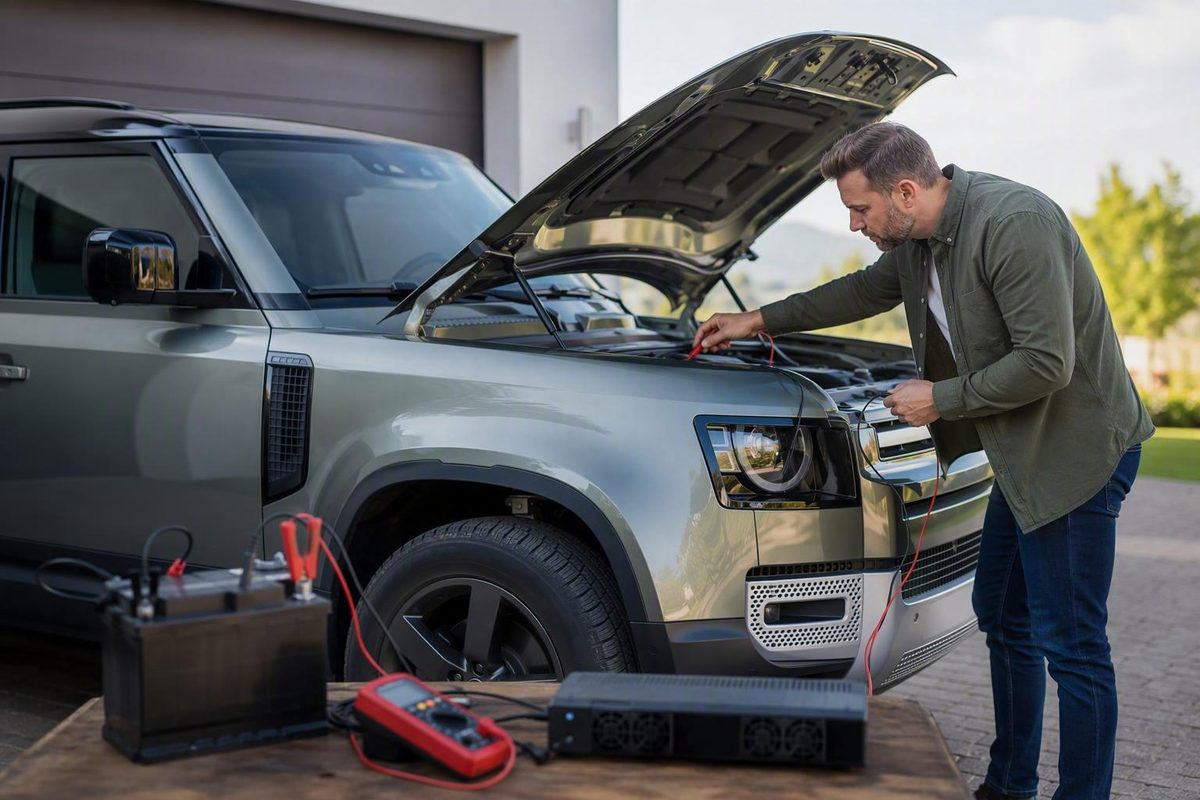
In a 48V mild-hybrid Land Rover, a “Stop Safely Electrical Fault Detected” warning followed by failing driver aids, engine shutdown, dimming or lost exterior lights, and a dead 12V battery points strongly to loss of DC/DC converter charging. A flat battery alone does not. If running voltage remains in the 13.5–14.8V test range but resting voltage or battery capacity is poor, suspect the 12V battery; if running voltage fails to rise despite valid 48V input and controls, ask the dealer to diagnose the converter and check recall 26V248000. Stop driving when instructed because drive power and exterior lighting may be lost.
Choose the model and year, enter both voltage readings, then follow the result and dealer checklist.
This screening tool separates model-year recall fit from the voltage pattern. VIN confirmation and diagnosis are still required.
Unknown is allowed; battery pass/fail needs a proper test.
Tool’s active-charging range: 13.5–14.8V.
- Check the 17-character VIN for campaign 26V248000.
- Ask for a charged-battery load test and converter input/output measurements.
| Model | Years Supported by Supplied Evidence | Campaign Screen | What Still Decides |
|---|---|---|---|
| Range Rover MHEV | 2020–2024 | Potentially included | VIN, configuration, production details |
| Range Rover Sport MHEV | 2019–2024 | Potentially included | VIN, configuration, production details |
| Range Rover Velar MHEV | — | Listed; years not supplied | VIN and dealer campaign record |
| Range Rover Evoque MHEV | — | Listed; years not supplied | VIN and dealer campaign record |
| Discovery MHEV | — | Listed; years not supplied | VIN and dealer campaign record |
| Discovery Sport MHEV | — | Listed; years not supplied | VIN and dealer campaign record |
| Defender MHEV | — | Listed; years not supplied | VIN and dealer campaign record |
| Other Land Rover | — | Not established here | Architecture, VIN and service information |
Source: NHTSA campaign 26V248000 details and model ranges supplied in the article; 13.5–14.8V is the topic brief’s running-voltage screening range, not a universal model specification. Unknown values are shown as —.
Treat a Stop-Safely Warning as an Immediate Stop Instruction
In an affected Land Rover or Range Rover 48V mild hybrid, a failed DC/DC converter can stop the mild-hybrid system from charging the conventional 12V system. The battery then carries the low-voltage load without being replenished. As its available energy falls, the vehicle may disable functions, issue multiple electrical faults, shut down, or fail to restart.
The strongest converter clue is verified loss of 12V charging—not merely a flat battery. A discharged battery, red battery symbol, unavailable stop/start, slow cranking, clicking, or no-start fits the pattern but does not identify the failed component by itself.
| What You Notice | Likely Meaning | Action |
|---|---|---|
| Intermittent charging warning or unavailable stop/start | Early charging fault, weak battery, or temporary low voltage | Record it and arrange testing |
| Repeated discharge, unrelated warnings, resets, or slow cranking | Battery is failing or not being charged | Get a complete battery and charging-system test |
| Red warning, stop-safely message, lost drive power or lights | Serious low-voltage or other electrical failure | Stop safely and request assistance |
The wording “Stop Safely Electrical Fault Detected” has been reported in connection with these failures. Exact wording varies by model, software, and market; official recall information does not catalog every dashboard message. A third-party report attributes that wording to Land Rover and describes the converter as the link supplying the 12V side from the 48V system (reported warning and converter explanation).
Campaign 26V248000 identifies loss of 12V charging as the central defect consequence and says complete loss of drive power and exterior lighting may follow. Burning odors and intermittent warnings are not listed as official recall symptoms; they come from owner reports.
There is no proven universal sequence or dependable amount of driving time remaining. A vehicle may lose driver-assistance and convenience functions as voltage falls, then suffer engine or drive-power loss and finally lighting failure, but it may skip stages or fail suddenly. If the display says to stop safely—or drive power or exterior lighting is being lost—treat the instruction literally.
The 48V Converter Keeps the 12V System Alive
Relevant mild-hybrid electric vehicles have a 48V side for mild-hybrid generation and energy storage, plus a conventional 12V side for control modules and much of the vehicle’s electrical equipment. The DC/DC converter steps the 48V supply down to support the low-voltage system and charge its battery.
This differs from an older vehicle in which a conventional 12V alternator directly supports the low-voltage system. The converter performs an analogous charging role in the relevant MHEV architecture, but it is not simply another name for an alternator.
The failure chain is straightforward:
- The converter stops delivering usable low-voltage output.
- The 12V battery continues powering control modules and other loads.
- The battery is not adequately replenished.
- Available energy and system voltage decline.
- Functions become unavailable and modules report faults.
- The vehicle may shut down or fail to restart.
This is why a 48V-system component can look like an ordinary dead battery. When 12V voltage becomes unstable, symptoms can spread across systems that are not independently defective.
A 48V-to-12V MHEV converter is not a cabin AC inverter, a Voltage Quality Module, or a conventional engine-driven 12V alternator. Different powertrains use different charging architectures. Do not assume every Land Rover, plug-in hybrid, or vehicle carrying the same model badge uses this arrangement.
Campaign 26V248000 describes the defect narrowly: an internal fault in the DC/DC converter’s boost-control microchip can cause the 12V system to stop charging. A broad model-year search may return unrelated campaigns as well as the converter recall (NHTSA vehicle-query results).
Falling Voltage Can Disable Unrelated Systems in Sequence
Early or intermittent signs include a charging-system warning, red battery symbol, unavailable stop/start, faster-than-expected battery discharge, or a warning that clears after restart. These establish an electrical condition, not an internal converter defect.
As voltage falls, infotainment may reboot, accessories may slow, HVAC output may change, lighting may fluctuate, and several unrelated warnings may appear together. ABS, SRS, gearbox, parking-brake, driver-assistance, or communication warnings do not necessarily mean every named system has failed. Their modules all depend on stable low-voltage power.
Late signs include slow cranking, a click without a start, complete no-start, immobilization after parking, electrical shutdown while operating, and loss of drive power or exterior lighting. NHTSA identifies the last two as possible consequences after 12V charging is lost, but does not promise advance warning.
Commercial specialist guidance describes charging warnings, battery discharge, infotainment reboots, HVAC slowdown, headlamp flicker, slow cranking, and no-start as possible stages. It recommends code scans, live electrical data, load testing, and connector inspection rather than diagnosis by symptoms alone (specialist symptom and testing overview).
Owner reports can explain how a fault presents but cannot establish failure rates or predict a particular vehicle’s outcome. Some warnings reportedly disappear for hours or days; other vehicles become immobilized abruptly.
Running Voltage Separates Charging Loss From Battery Failure
A dead 12V battery does not prove converter failure. The decisive first comparison is the battery’s resting condition versus what happens when the vehicle is operating and expected to support the 12V system.
For the decision tool above, 13.5–14.8V running indicates charging. A healthy demonstration vehicle held its low-voltage system near 14V after startup, illustrating active charging, although that observation is not a universal Land Rover specification or a standalone pass/fail rule. If your model-specific service information specifies another range, use it.
If running voltage sits within the stated test range but the battery repeatedly goes flat, test the battery’s state of charge, capacity, conductance, and performance under load. Also check for key-off drain. If running voltage does not rise, the charging path needs diagnosis—but that still does not prove the converter itself is internally defective.
Possible lookalikes include:
| Possible Cause | Why It Looks Similar | Distinguishing Test |
|---|---|---|
| Weak or wrong 12V AGM battery | Voltage drops under load | Charge, capacity and load tests |
| Parasitic drain or awake module | Healthy battery goes flat while parked | Key-off current monitoring after sleep |
| Accessory, tracker or dashcam | Adds continuous load | Isolate aftermarket wiring |
| Wiring, fuse, connector or ground | Interrupts converter path | Inspection and voltage-drop testing |
| Missing 48V input | Converter cannot produce output | Compare input with output |
| 48V battery or starter-generator fault | Disrupts mild-hybrid energy supply | Scan data and generation tests |
| Software or communication fault | Inhibits operation or creates network codes | Verify software and communications |
| Belt or tensioner fault | Disrupts belt-driven equipment | Mechanical inspection |
| Battery-management procedure missed | Replacement may be managed incorrectly | Check specification and registration |
Charging the existing battery or fitting a new one may temporarily restore enough energy to wake modules and start the vehicle. If charging output remains absent, the new battery again supplies the vehicle’s loads and eventually discharges.
Recall status and diagnosis remain separate. An eligible VIN can still have a weak battery, drain, broken wire, or belt problem. A vehicle outside campaign 26V248000 can have similar charging loss for another reason.
Converter Diagnosis Requires Input and Output Evidence
A sound diagnosis starts with the exact model, model year, engine, powertrain, market, VIN, and confirmation that the vehicle is an applicable 48V MHEV. The badge alone is insufficient.
The 12V battery should be charged before interpreting other tests. The technician should confirm its type, specification, age, replacement history, capacity under load, and whether any model-specific battery-management procedure was completed.
All relevant modules should be scanned before codes are cleared. Low voltage can create communication errors in modules that are not defective, so a code naming the converter, starter-generator, parking brake, or another module may identify where a problem was detected rather than the root cause.
Accessible grounds, harnesses, fuses, converter connectors, and nearby wiring should be checked for looseness, corrosion, physical damage, heat discoloration, or damaged insulation. Work involving the 48V system belongs to trained, properly equipped personnel.
The technician then needs to compare the converter’s expected 48V-side supply, ground, control commands, and network communication with its low-voltage output under load. No low-voltage output does not automatically prove an internal converter failure: the unit cannot deliver its intended output without input energy, communication, sound grounds, and intact wiring.
A diagnostic demonstration found expected voltage absent on the suspect vehicle’s converter 48V side, so it could not conclusively identify the converter as the failed component (diagnostic demonstration). This is precisely why input and output measurements must be interpreted together.
A commercial repair provider associates P0D33, P0A94, P0480, U0064, and U3008 with converter hardware, cooling, communication, or ground issues. Those associations can vary by module, powertrain, market, and software version; none proves an internal defect without model-specific definitions and live testing.
Do not improvise probes, bypasses, resets, disassembly, or component substitution on the 48V system.
Recall 26V248000 Covers Certain Land Rover MHEVs
NHTSA campaign 26V248000 concerns DC/DC converter failure in certain Jaguar Land Rover mild hybrids. The associated Land Rover campaign numbers are D126 and H575.
The affected population includes certain:
- 2020–2024 Range Rover MHEVs
- 2019–2024 Range Rover Sport MHEVs
- Range Rover Velar MHEVs
- Range Rover Evoque MHEVs
- Discovery MHEVs
- Discovery Sport MHEVs
- Defender MHEVs
The supplied evidence does not give model-year ranges for Velar, Evoque, Discovery, Discovery Sport, or Defender, so the checker marks those years as requiring a VIN check rather than guessing. Eligibility depends on the exact mild-hybrid configuration, production details, market, and VIN. Gasoline, diesel, plug-in-hybrid, and non-hybrid versions carrying the same model name may use different hardware or fall outside the campaign.
The campaign record reported that the remedy was under development and that interim owner letters were mailed June 17, 2026. The evidence available here does not establish that a final remedy has since become available. Ask a Land Rover dealer to confirm both VIN eligibility and current remedy availability.
A reported class action alleges that an earlier recall did not resolve owners’ converter problems and that Jaguar Land Rover concealed the defect. These are allegations, not engineering findings about every vehicle or the effectiveness of a specific repair. The report identifies Robert Sumrell v. Jaguar Land Rover North America, LLC in the U.S. District Court for the District of New Jersey (lawsuit report). Litigation does not replace the campaign record, VIN eligibility, or diagnosis.
Only a VIN Search Establishes Recall Eligibility
Find the 17-character VIN through the lower-left windshield or on registration and insurance documents. Enter it in NHTSA’s recall search, save the result, and ask a Land Rover dealer to search its records for 26V248000, D126, H575, and any market-specific action.
A result showing zero unrepaired recalls means only that no open safety recall was identified for that VIN at that time. It does not prove the vehicle was never recalled, that a previous recall was not completed, that the vehicle cannot develop a similar fault, or that a newly announced campaign has loaded all affected VINs.
NHTSA says VIN results may omit completed recalls, some newly announced campaigns with incomplete VIN populations, non-safety campaigns, and international recalls. VINs can be added over time, so rechecking is appropriate (NHTSA recall-search instructions).
Manufacturers must provide the applicable safety-recall remedy without charge through the recall process. NHTSA describes possible remedies as repair, replacement, refund, or, rarely, repurchase. This does not guarantee a particular repair, timetable, loan vehicle, reimbursement, refund, or repurchase for an individual owner.
Bring Voltage Results and the Full Failure Record to the Dealer
For an active red warning, burning odor, lost drive power, or exterior-lighting problem, move out of traffic if the vehicle remains controllable and arrange roadside assistance. Do not continue merely because it still moves; there is no reliable remaining-mileage estimate.
For an intermittent fault, save the exact warning text, symbols, photos or video, date and time, driving state, weather, electrical loads, parking duration, recent jump-starts, external charging, and whether the warning cleared after restart. Include battery age, specification, test results, invoices, replacement history, and previous work on the converter, starter-generator, 48V battery, belt drive, software, wiring, or modules.
Ask the workshop to document the 12V battery’s state of charge and load-test result; whole-vehicle codes and freeze-frame data; 48V input and control conditions; converter low-voltage output under load; and wiring, connector, fuse, and ground findings. Ask what evidence supports replacing the converter, battery, wiring, or any other component.
After repair, the workshop should test the charged 12V battery, rescan for returning faults, verify charging under load, and confirm that damaged connectors or wiring were corrected. A deeply discharged battery must be tested for its ability to retain charge rather than assumed healthy.
A New Battery Can Die If Charging Is Still Absent
A failed converter can discharge a new, correctly charged 12V battery because that battery continues supplying the vehicle without replenishment. Temporary recovery after replacement does not show that the repair succeeded.
It also does not prove converter failure. A drain, wiring defect, missing 48V supply, wrong battery, missed battery-management procedure, or another charging fault can flatten the replacement. The recall answer is VIN-specific; the repair answer comes from battery testing and complete input-output diagnosis.