
Does O’Reilly Pay Cash for Old Car Batteries? $10 Policy
O’Reilly offers $10 gift cards for qualifying non-core car batteries. Check state limits, exclusions, core refunds, and your garage’s total.
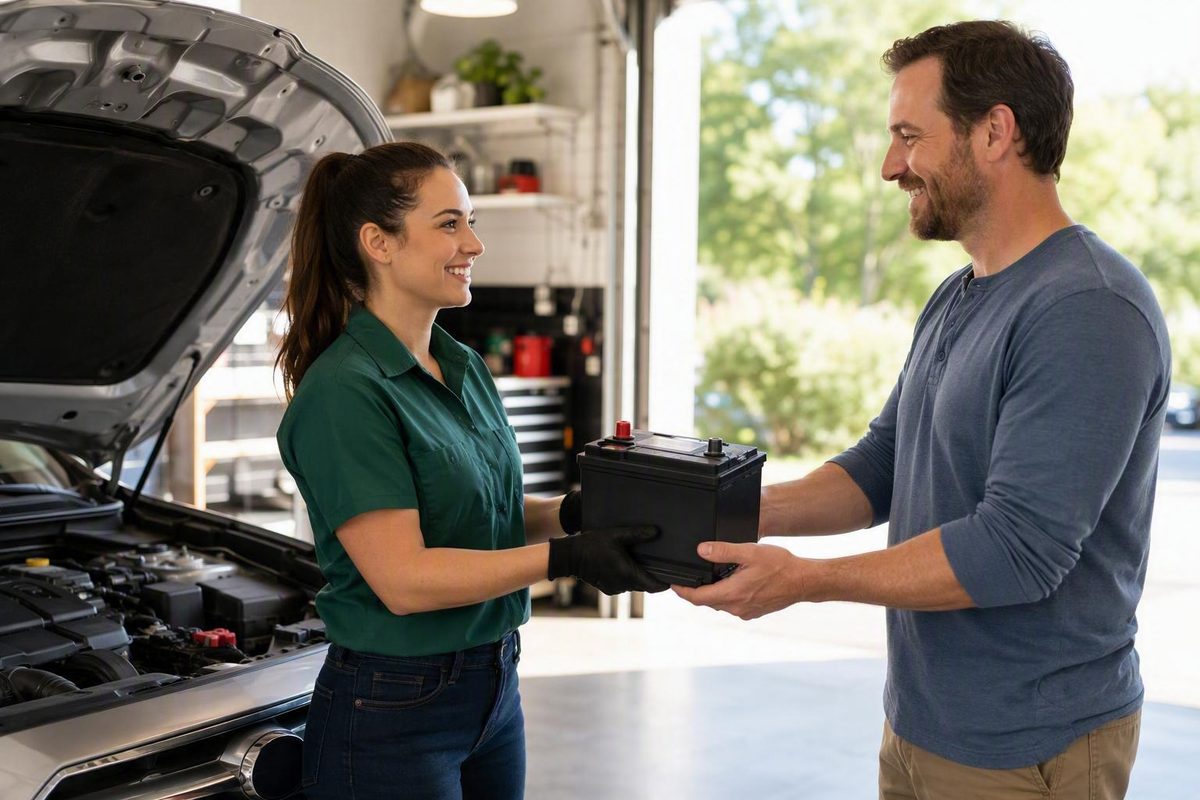
O’Reilly does not pay cash for old car batteries, but it offers a $10 O’Reilly gift card for each qualifying, undamaged, non-core lead-acid car or truck battery—with no replacement purchase required. Three eligible batteries sitting in a garage can therefore produce $30 in store credit in one trip at most locations, subject to participation and local restrictions. O’Reilly identifies the incentive as a $10 gift card.
The reported daily cap is five qualifying batteries per customer at most stores, six in California, and two in Florida. Those are limits, not guaranteed approvals; each battery still has to meet the application, condition, chemistry, and non-core rules. AOL’s account reports the general and state-specific limits.
Enter the batteries in your garage and select your state; the calculator identifies the applicable route, value, and number of reward days.
Estimate the O’Reilly gift-card value and reward days for batteries already on hand. The default shows three qualifying batteries in a state with the general five-per-day cap.
| Reward Day | Batteries | Gift-Card Value |
|---|---|---|
| Day 1 | 3 | $30 |
The schedule applies the reported per-customer daily limit. Store participation and battery approval still control the actual result.
| Location | Daily Cap | Maximum Daily Value |
|---|---|---|
| Most states Selected | 5 batteries | $50 |
| California | 6 batteries | $60 |
| Florida | 2 batteries | $20 |
Sources: O’Reilly battery recycling policy and reported state limits. Values are potential gift-card totals, not guaranteed payments.
Why The Core-Charge Assumption Sounds Right
The usual assumption is that an old battery has value at an auto-parts counter only when it is handed over during a replacement purchase. That is how the familiar core-charge system works: the retailer assesses a charge with the new battery, then refunds the applicable charge when the corresponding old battery is returned.
O’Reilly allows 45 days from the new-battery purchase date to return that old battery for the applicable core-charge refund. Its published policy does not specify whether the refund arrives as cash, a reversal to the original payment method, or another form. O’Reilly explains the incentive and 45-day core-return period.
That received wisdom is correct for a battery tied to a recent purchase. If a receipt shows a core charge, returning the old battery through that transaction is the proper route. The same battery should not be expected to earn both a core refund and a $10 recycling gift card.
The assumption fails when it is applied to unrelated batteries already sitting in a garage. O’Reilly’s separate recycling incentive covers qualifying non-core car and truck batteries. A new-battery purchase is not required for that program, although the reward is store credit rather than cash.
The Three Return Routes Produce Different Results
“Returning a battery” can describe three distinct transactions. Identifying the correct one prevents a customer from asking for cash when the available benefit is a gift card—or asking for the gift card when a core refund applies.
| Battery Situation | Correct Route | Potential Result |
|---|---|---|
| Eligible battery not tied to a purchase | Recycling incentive | $10 O’Reilly gift card |
| Battery tied to a recent O’Reilly purchase | Core return | Applicable core-charge refund |
| Accepted battery that does not earn a reward | Free recycling | No payment guaranteed |
The $10 incentive is the closest O’Reilly’s published policy comes to buying an unsolicited old battery. A gift card is not cash, and the policy does not say that the card can be redeemed for cash.
Ordinary recycling is also separate from the reward. O’Reilly describes covered lead-acid battery recycling as a free service, generally without requiring a replacement purchase. Free acceptance means the store handles an accepted battery without charging for recycling; it does not promise compensation for every battery.
A Qualifying Battery Must Clear Four Tests
The clearest candidate is an intact lead-acid car or truck battery that is not connected to a core charge. A battery does not qualify merely because it is dead, old, or unwanted.
| Test | Gift-Card Requirement |
|---|---|
| Application | Qualifying car or truck battery |
| Chemistry | Covered lead-acid type |
| Condition | Intact, without cracks or leaks |
| Transaction | Not being returned as a purchase core |
The transaction status is particularly important. In this policy, non-core does not describe a battery design. It means the battery is being submitted under the separate recycling incentive rather than returned to recover a core charge from a replacement purchase.
If the battery has been sitting in the garage and is unrelated to a recent O’Reilly purchase, ask whether it qualifies for the non-core recycling gift card. If a replacement was recently purchased, check the receipt before choosing that route.
The available official evidence does not establish that every battery bought from another retailer qualifies. It also does not establish a universal nationwide rule concerning receipts or identification. Tell the intended store where the battery came from and ask whether documentation is required.
Daily Caps Determine How Many Reward Days You Need
At $10 for every qualifying battery, the arithmetic is straightforward until the state cap applies.
| Location | Reported Daily Cap | Maximum Daily Value |
|---|---|---|
| Most states | 5 batteries | $50 |
| California | 6 batteries | $60 |
| Florida | 2 batteries | $20 |
A garage with three eligible batteries falls under the cap in most states and California, producing a potential $30 gift-card total in one reward day. In Florida, the same three batteries require at least two days because only two can earn the incentive per customer per day under the reported limit.
A publicized River City Wheels example showed two $50 O’Reilly gift cards after the business reportedly brought in ten batteries without making a purchase. That establishes that a purchase-free transaction was reported, but it does not establish that ten batteries can be rewarded at every store in one day. The account came through social media and third-party reporting rather than a nationwide transaction guarantee.
Store participation, local restrictions, and battery-by-battery eligibility can still reduce the result. Confirm the current limit with the intended location before loading several heavy batteries for transport.
Several Battery Categories Do Not Earn The $10 Reward
O’Reilly’s detailed policy excludes lead-acid or AGM batteries used in motorcycles, ATVs and UTVs, golf carts, marine applications, and lawn and garden equipment from the gift-card incentive. Some of these batteries may still be accepted for free recycling, but acceptance and compensation are separate decisions.
That distinction produces two useful store questions: whether the location can recycle the battery and whether that particular battery earns the gift card. A yes to the first does not imply a yes to the second.
O’Reilly also says cracked or leaking batteries do not qualify for the reward, and employees may refuse damaged batteries. Do not transport a visibly cracked or leaking battery on the assumption that the store must accept it. Describe the damage by phone and obtain instructions from the store or an appropriate municipal or hazardous-waste service first.
Automotive, marine, and powersport lithium batteries are outside O’Reilly’s stated recycling acceptance. Check the label rather than identifying chemistry from the case size, voltage, or equipment alone.
| Battery Type Or Condition | $10 Reward | Recycling Position |
|---|---|---|
| Qualifying intact car/truck lead-acid | Potentially eligible | Accepted where program applies |
| Motorcycle, marine, lawn, ATV/UTV or golf-cart | Excluded | Some lead-acid types may be recycled free |
| Cracked or leaking | Excluded | Acceptance not guaranteed |
| Covered lithium applications | Excluded | O’Reilly says it cannot recycle them |
Store Credit And Core Refunds Must Stay Separate
For a garage battery unrelated to a purchase, describe the visit as free battery recycling with possible gift-card eligibility. That wording identifies the correct program without presuming approval.
For a battery associated with a replacement purchase, use the core-return route. Check whether the purchase remains within the published 45-day return period and ask the store how the refund will be issued. The published policy does not provide a universal refund method or a core-charge amount, so neither should be assumed.
State battery laws can govern deposits, fees, covered-battery definitions, and purchase-related refunds. Those legal mechanisms do not convert O’Reilly’s voluntary recycling gift card into cash, nor do they establish that an unrelated garage battery is owed a statutory payment.
Before the trip, give the store the facts that control eligibility: the battery’s application, the chemistry printed on its label, its physical condition, whether it is tied to a recent purchase, the number being brought, and whether it came from another retailer. Ask which daily cap and documentation rules the location applies.
Safe Handling Comes Before The Reward
A $10 gift card is not a reason to improvise removal or transport. Batteries store substantial energy. Follow the vehicle manufacturer’s removal instructions, wear eye protection, remove metal jewelry, and disconnect the negative terminal first. If removal is unfamiliar or access is difficult, have a qualified person handle it. Car Battery Hub’s terms include the applicable battery-safety precautions.
O’Reilly’s available policy does not publish one universal packaging or transport procedure for intact batteries. Ask the receiving store how it wants the battery presented. A cracked or leaking unit requires instructions before it is moved.
The Recycling System Is Broad, But Eligibility Is Local
Battery Council International reports a 97.7% U.S. lead-battery recycling rate for 2020–2024, commonly rounded to nearly 98%. Its industry study also reports that more than 174 million lead batteries are recycled domestically each year and that recyclers recovered more than 11 billion pounds of lead during the study period. BCI summarizes the recycling rate and collection scale.
Those figures show the reach of the wider lead-battery collection system. They do not prove that a particular O’Reilly store participates, that a damaged battery will be accepted, or that an individual battery qualifies for a reward.
The practical distinction remains narrow: an intact, qualifying non-core car or truck battery may earn a $10 O’Reilly gift card without a new purchase. A battery tied to a recent O’Reilly purchase belongs in the core-refund process. An excluded or damaged battery may receive no reward even if an appropriate recycler can accept it.